

I was recently chatting with a friend about an unfortunate driving incident in our neighborhood. We bemoaned drivers who can no longer or just do not pay attention pedestrian crossings. This in turn led us to discussing the increase in pedestrian-friendly areas in our lovely city of Hamburg. In particular, we appreciate the more recent moves to make Jungfernstieg and the area around the Alster a private car-free zone. It is easily accessible with public transport and it makes the shopping experience more pleasant.
This got me thinking about urban design and more specifically what I like about other cities I have lived in or visited. In Europe, most cities are very old and established. They have a mix of architecture through centuries, not just decades. They carry the ideas urban planners who designed for people walking or moving goods with carriages and horses. I particularly am fond of the roundabouts in the United Kingdom that were designed to keep traffic flowing.
Interestingly, in Germany, the government long ago set a goal of significantly increasing the amount of green space, especially near residential developments. Their stated aim is to ‘harmonize social, economic, health-related and environmental planning requirements.’ I love that government white papers state “Authorities, citizens, companies and stakeholders must regard the development and maintenance of high-quality, sustainable public spaces, including open green spaces, as a common task,’’ as part of urban panning directives.
While making citifies walkable may seem to some as a climate-reactionary, a way to reduce vehicle emissions, the benefits have long been touted. Urban theorists, like Jane Jacobs in the 1960s, found that urban vitality, or vibe, is only found when human density is combined with the physical routes and spaces that allow for intense and diverse human overlap, imagine a ‘sidewalk ballet.’ These daily interactions between neighbors and strangers creates a community built on mutual trust.
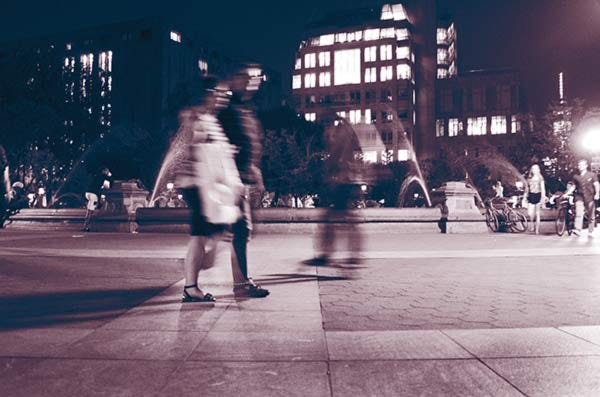
Phil Roeder, Nighttime in Greenwich Village
Photograph public domain
I see this in my own neighborhood. Within a 15-minute walk, I can access doctors, pharmacy, hair dressers, bakeries, restaurants, and shopping. It was the same when we lived in London, well frankly most cities we have visited in Europe. The tree-lined streets, the nearby parks, the wide sidewalks and bicycle lanes, as well as reliable public transportation, all make it a comfortable place to live. In contrast, where I grew up in a small town in Tennessee, one always had to get in a car to get anywhere. And, there were hardly sidewalks in our residential areas to even casually run into neighbors.
As we a a society continue to urbanize, I am glad to advocate for public spaces. We need them not only for improving air quality and reducing urban heat, but as importantly for relaxation and fostering social interaction.