

Art and the Park Bench: From a Symbol of Hierarchy to a Modern Social Space
My son and I went to Paris and had a chance to go through the Louvre. We came across Thomas Gainsborough’s Conversation in a Park, from the 1700s. The painting depicts a couple on a park bench, believed to be a self-portrait of Gainsborough and his new wife, Margaret, painted the year they married — an idealized vision of the society he hoped to join.
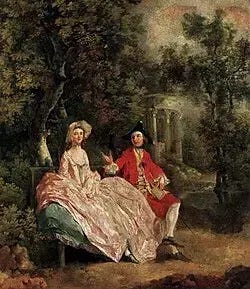
The space between them is a modest distance, though there are no others in the picture. They sit in the shade of a tree with lush foliage around them as if they are taking a break from a walk. The gentleman is speaking animatedly, and the woman is sitting near him listening attentively. They clearly seem to be enjoying the “third space” the park bench offers: intimacy for a conversation without breaking the social conventions of the time about where and how such moments were acceptable between the sexes.
After we left the exhibit, my mind kept coming back to that painting and who used park benches long ago. They started as a symbol of status and social hierarchy, much like parks themselves, not carrying the egalitarian view we have of them now.
In Ancient Times, Seating Was a Privilege
For instance, starting in Ancient Egypt, drawings and sculptures often show that those who sat in chairs and stools were rulers and other figures of status — though it wasn’t absolute; the Louvre’s own famous *Seated Scribe* is a reminder that seating occasionally extended beyond royalty. In paintings and frescoes from classical Greece and Rome, we see public seating, or stone benches, used to engage citizens in public discourse with speakers or performers. This is when the bench appears to become more open to the general public, and not always located in a park. It created a place for conversation and an exchange of ideas.
The Aristocracy Claims the Space
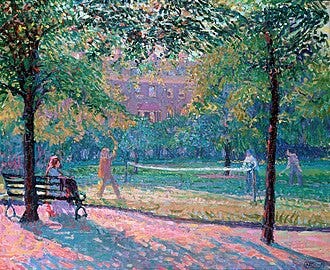
Looking into later paintings from the early 1900s, I came across Game of Tennis by Spencer Frederick Gore. What I especially liked about this one was that it features two women, one playing tennis and the other watching while seated on the bench. Gore’s father, Spencer Gore, won the first-ever Wimbledon Championship in 1877, so the setting is more likely near their home outside London or even on their property. The style and form are like the French painters of the time who captured the aristocrats at play in these outdoor settings.
Accessibility to Nature Is Everyone’s Right
Then, as we move into the 20th century, two paintings really caught my eye: Old People on a Park Bench by David Stefan Przepiora and The Park Bench by Horace Pippin. The contrast is what interested me: a place for gathering people, and a place for solitary reflection. In Przepiora’s painting, the older people are ordinary people, not high society. They are engaged in watching society, keeping an eye on the movements of those who pass by as they reflect. In Pippin’s, the lone person appears deep in thought, nothing much going on around them. While their paintings are different in style and social representation, they both depict, to me, the bench as a place of refuge or rest, a place to pause.
More recently, I came across a project from a UK artist, Lizzie King “You Belong Here,” commissioned for the Rediscovering Salford exhibition in 2021. She created a series of photographic prints and postcards from benches in Peel Park, one of the first public parks in the country. It was created in 1846 through public fundraising and was free to use. It was a much-needed way to improve the overall wellbeing of residents in Victorian times who often lived in cramped accommodations. It brought all Salford residents together then and now, with the addition of the free Salford Museum & Art Gallery, which sits right in Peel Park and where you can see the Old People on a Park Bench by Przepiora.